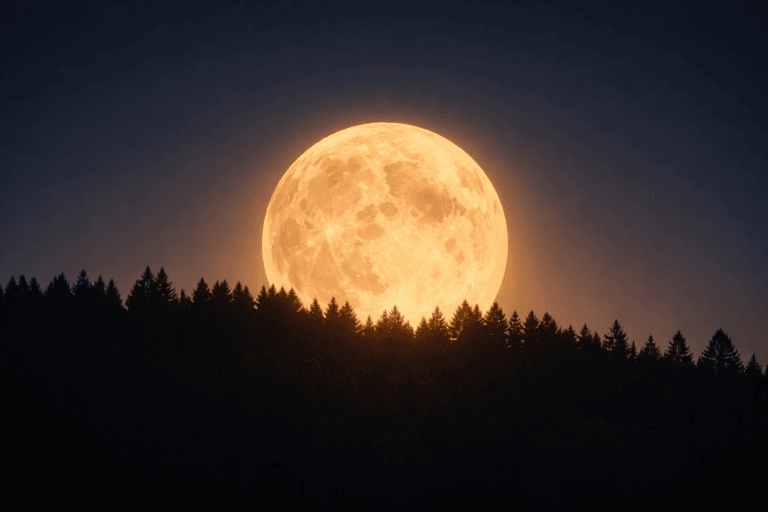
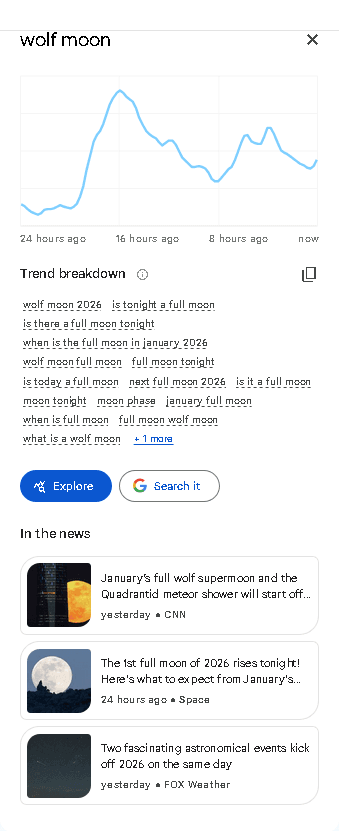
Searches for “wolf moon 2026,” “full moon tonight,” and “is there a full moon tonight” have surged in recent days after the first full moon of 2026 lined up with “supermoon” coverage and the Quadrantid meteor shower window.
Part of the Insight Trends Explained series.
→ View the full index of insight-related search spikes.
✅ Here’s what’s confirmed — and what isn’t (Reality Check):
- The Wolf Moon is the traditional name commonly used for January’s full moon.
- Peak full illumination is Saturday, Jan. 3, 2026 at ~5:03 a.m. EST (often also listed as 10:03 GMT).
- Many outlets are calling it a supermoon (a full moon occurring near perigee), meaning it can appear somewhat larger/brighter than an average full moon.
Google Trends Data:
⚠️ What’s Still Unknown
- How “super” it looks to you (the size/brightness difference is subtle and varies by perception and conditions).
- Exactly how many Quadrantid meteors you’ll see where you live (moonlight + clouds + local light pollution can drastically cut visibility).
- Your best viewing time tonight (moonrise timing depends on location and can shift the best photo/viewing window).
If you’re seeing posts claiming “perfect meteor conditions confirmed,” those claims are overstated—full-moon glare is a major limiting factor this year.
🔥 Why This Is Trending Right Now
Several forces are driving the sudden spike in interest:
- Primary Trigger
The first full moon of 2026 (Wolf Moon) hit its peak illumination on Jan. 3, prompting “is it full tonight?” searches. - Market or Cultural Pressure
“Supermoon” framing makes it feel rarer and more urgent to catch, especially for photos and casual skywatchers. - Algorithmic Amplification
News and social posts paired it with the Quadrantid meteor shower, creating a “double event” narrative that spreads fast.
This follows a familiar pattern:
Announcement → Curiosity → FOMO → Search spike
🧭 What This Means If You’re Affected
The Upside
- You can still see it: even after the exact peak time, the moon typically looks “full” across nearby nights to most observers.
- Great photo opportunity (especially at moonrise near the horizon).
- Easy, low-cost skywatching—no gear required.
In short: If you want the “full moon experience,” you can still catch it around this window.
The Tradeoffs
- Meteor viewing is compromised: bright moonlight washes out many Quadrantids.
- Clouds/light pollution can make it underwhelming (especially in cities).
- It can look “normal” if you’re expecting a dramatic size difference.
⏳ Should You Act Now — Or Wait?
You might want to wait if:
- You mainly care about meteor watching (a darker-moon phase is better).
- Your forecast is cloudy where you are.
- You want a “bigger wow” moment than a subtle supermoon difference.
You may not want to wait if:
- You want a clean full-moon photo this weekend. The Washington Post+1
- You’re doing a family/community “look up tonight” moment.
- You’re capturing the first full moon of the year as a calendar marker. Almanac+1
Right now, this is best described as: confirmed (timing/name), with conditions-dependent viewing quality.
👀 What to Watch Next
If this trend continues, the next key signals will likely be:
- Local sky conditions (cloud cover changes the experience).
- The Quadrantids peak window (Jan 3–4, narrow peak).
- The next widely-covered sky event (e.g., Jupiter at opposition later in January).
Once those land, searches will likely shift from:
“What is it?” → “Can I see it tonight?” → “Where’s the best spot near me?”
❓ FAQ — Wolf Moon 2026
Is Wolf Moon 2026 officially confirmed?
Yes. Major skywatching references list the January 2026 full moon (“Wolf Moon”) peaking around 5:03 a.m. EST on Jan. 3, 2026.
When is the best time to see it?
The exact peak is early morning Jan. 3, but it typically appears full across the nearby nights; moonrise around sunset is often the most dramatic for viewing and photos.
How “super” is this supermoon?
It may appear somewhat larger/brighter than an average full moon because it’s near perigee, but the difference is usually subtle without a direct comparison.
Will the Quadrantid meteor shower be good this year?
It’s a strong shower, but full moon brightness will hide many fainter meteors—expect reduced visible counts unless you have very dark skies.
📚 Sources & Technical Background
Primary reporting (2026)
Secondary analysis (2026)
Historical context (evergreen)
Technical background reference (2026)