Searches for “Gen Z” have spiked amid a wave of reporting on AI anxiety, career uncertainty, and fears about losing human creativity. Here’s what’s confirmed, what’s still unclear, and why this conversation is accelerating now.
Part of the Insight Trends Explained series.
→ View the full index of insight-related search spikes.
✅ Here’s what’s confirmed — and what isn’t (Reality Check):
- A measurable share of Gen Z reports anxiety about AI. For example, an Inside Higher Ed summary of survey findings reports 53% of Gen Z adults saying AI makes them feel anxious.
- Mainstream business media is actively covering “AI anxiety” among Gen Z, framing it as both fear of obsolescence and frustration with stereotypes about Gen Z.
- Recent stories specifically describe Gen Z fearing loss of “humanity” or cognitive effects as AI becomes more embedded in school and work.
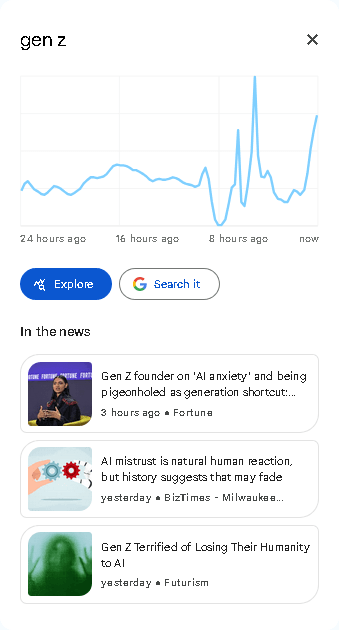
Google Trends Data
⚠️ What’s Still Unknown
- Whether the search spike is driven more by career fears (jobs, hiring, wages) or identity/culture fears (“humanity,” creativity, authenticity). Current reporting suggests both, but it’s not cleanly quantified.
- How representative the most viral anecdotes are versus broader Gen Z sentiment (lots of coverage, limited standardized measurement across the same questions).
- Whether this is a temporary news-cycle spike or the start of a longer public attitude shift tied to 2026 hiring/education changes.
If you’re seeing posts claiming “Gen Z is universally terrified of AI,” those claims are still speculative at this stage.
🔥 Why This Is Trending Right Now
1) Primary Trigger
A burst of high-visibility stories in the last few days framed the topic sharply—e.g., Fortune’s recent pieces on Gen Z’s AI fear/obsolescence concerns and Futurism’s story about fear of “losing humanity.”
2) Market or Cultural Pressure
The pressure points are real: young workers are entering a labor market where AI is increasingly used in workflows, and Gen Z worries include career direction, job stability, and how they’re judged for using AI tools.
3) Algorithmic Amplification
The theme is tailor-made for social sharing (fear + identity + future-of-work), so it spreads fast across news aggregation and social platforms—driving searches as people try to figure out what’s hype versus reality.
This follows a familiar pattern:
Announcement → Curiosity → Anxiety → Search spike
🧭 What This Means If You’re Affected
The Upside
- Faster skill-building becomes mainstream: more people pursuing certifications/self-learning to stay competitive.
- Clearer workplace norms can emerge (what AI use is acceptable, how to disclose it, how to evaluate work fairly).
- More honest education conversations about when AI helps vs harms learning outcomes (especially for early-career development).
In short: this could push better AI literacy and better norms—if institutions respond well.
The Tradeoffs
- Anxiety + distrust can cause paralysis (avoiding tools entirely or using them secretly).
- Skill atrophy risk if AI replaces core thinking too early without guardrails (a concern raised in education discussions).
- Identity/meaning concerns (“am I still me if AI does the thinking?”) can become a cultural wedge issue instead of a practical policy/workflow issue.
⏳ Should You Act Now — Or Wait?
You might want to wait if:
- You’re only reacting to headlines and don’t yet have a specific use case or skill gap to address.
- Your workplace/school has unclear rules and you’d be penalized for experimenting openly.
- You’re feeling anxiety-driven “doom learning” (consuming fear content without building a plan).
You may not want to wait if:
- AI is already changing workflows in your field and you need baseline competence to stay competitive.
- You’re early-career and can benefit most from building a small portfolio of AI-assisted work with transparent methods.
- You can set guardrails (when not to use AI) and use it to accelerate learning rather than replace it.
Right now, this is best described as: transitional.
👀 What to Watch Next
If this trend continues, the next key signals will likely be:
- More standardized survey results on Gen Z attitudes (anxiety vs excitement vs trust) across time, not just one-off snapshots.
- Employer disclosure norms (do companies encourage AI usage transparency or quietly punish it?).
- Education policy shifts on AI in coursework and assessment as schools try to balance learning integrity and tool reality.
Once those land, searches will likely shift from:
“What is it?” → “Is it worth it?” → “Should I use it (and how)?”
❓ FAQ — Gen Z AI Anxiety
Is “Gen Z AI anxiety” officially confirmed?
Partly. Multiple outlets are reporting it as a real theme, and at least one survey summary reports a majority of Gen Z adults saying AI makes them feel anxious, but the intensity and causes vary by context.
When did this spike become noticeable?
Coverage accelerated in late December 2025 with multiple stories published within days, which likely contributed to the short-term search spike.
How risky is it to lean into AI at school or work?
The risk isn’t just technical—it’s social and policy-based: some Gen Z workers report hiding AI use due to fear of judgment, suggesting norms and rules are still unsettled.
Is this just a repeat of earlier “tech panic” cycles?
There are similarities: an analysis piece argues mistrust is a common human reaction to major tech shifts and can fade, but AI’s pace and scope make the stakes feel higher to many people.
📚 Sources & Technical Background
- Primary reporting source: Fortune — “Gen Z founder on ‘AI anxiety’…”
- Secondary analysis source: Inside Higher Ed — survey summary on Gen Z anxiety about AI (2025)
- Historical context source: InsideWis / Wisconsin Technology Council (via University Research Park) — AI mistrust as a recurring human reaction (2025)
- Technical/cultural background reference: Futurism — “Gen Z Terrified of Losing Their Humanity to AI” (2025)