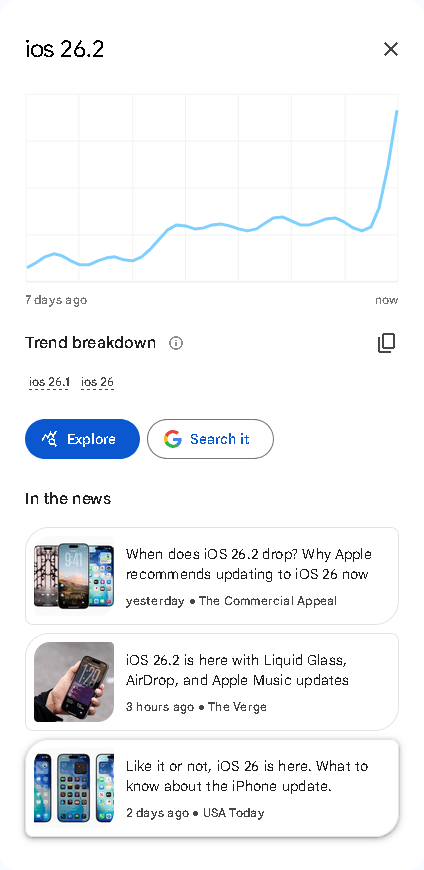
Searches for “iOS 26.2,” “iOS 26,” and “iOS 26.1” have surged in recent days after Apple released iOS 26.2 and multiple major outlets published same-day coverage. Here’s what’s actually confirmed, what’s still unknown, and why this is trending right now.
Part of the Tech Trends Explained series.
→ View the full index of technology-related search spikes.
✅ What’s Actually Confirmed (Reality Check)
Here’s what is officially confirmed so far:
- iOS 26.2 was released on December 12, 2025, according to Apple’s official security update documentation.
- Apple lists iOS 26.2 as the current latest version of iOS, indicating a broad public rollout rather than a limited test release.
- Apple recommends updating to the latest version due to security fixes and system improvements, consistent with standard iOS update guidance.
⚠️ What’s Still Unknown
- The full breakdown of user-facing changes beyond what Apple and major tech outlets have summarized.
- Whether any battery life, performance, or compatibility issues will emerge after wider adoption.
- How much of the interest is driven by security concerns vs. visual or feature changes.
If you’re seeing posts claiming “major redesign confirmed” or “game-changing update,” those claims are still speculative at this stage.
📈 Why This Is Trending Right Now
Several forces are driving the sudden spike in interest:
1. Primary Trigger
Apple officially released iOS 26.2, immediately followed by coverage from outlets like The Verge and USA Today highlighting what’s new and why users should update.
2. Market or Cultural Pressure
iOS updates often trigger anxiety around device performance, battery life, and security, especially for users on older hardware who want to know whether they should install immediately or wait.
3. Algorithmic Amplification
Once the update went live, search traffic was amplified by:
- News push alerts
- Tech YouTube explainers
- Social media posts reacting to visual and feature changes
This follows a familiar pattern:
Announcement → Curiosity → Anxiety → Search spike
🔍 What This Means If You’re Affected
The Upside
- Improved security through patched vulnerabilities.
- Incremental feature and usability updates included in the release.
- Staying current with Apple’s recommended software baseline.
In short: this is a stability-and-security-focused update rather than a radical shift.
The Tradeoffs
- Early adopters may encounter minor bugs or edge-case issues.
- Older devices could see performance variability until optimizations settle.
- Limited transparency on all under-the-hood changes at launch.
⏳ Should You Act Now — Or Wait?
You might want to wait if:
- You rely on critical third-party apps not yet confirmed compatible.
- Your device already struggles with performance on recent iOS versions.
- You typically avoid first-wave updates.
You may not want to wait if:
- Security updates are a priority for you.
- You’re already on iOS 26 and plan to stay current.
- You use newer iPhone hardware.
Right now, this is best described as: confirmed.
👀 What to Watch Next
If this trend continues, the next key signals will likely be:
- Follow-up Apple documentation clarifying fixes or known issues.
- User-reported performance and battery feedback.
- Minor patch releases addressing early bugs.
Once those land, searches will likely shift from:
“What is it?” → “Is it safe?” → “Should I update?”
❓ FAQ — iOS 26.2
Is iOS 26.2 officially confirmed?
Yes. Apple has publicly released iOS 26.2 and lists it as the latest version.
When did iOS 26.2 launch?
December 12, 2025.
Is this a major redesign?
No confirmed evidence suggests a major redesign. Changes appear incremental.
Is this just a repeat of previous iOS point releases?
Yes. Based on available information, iOS 26.2 follows Apple’s typical point-update pattern.