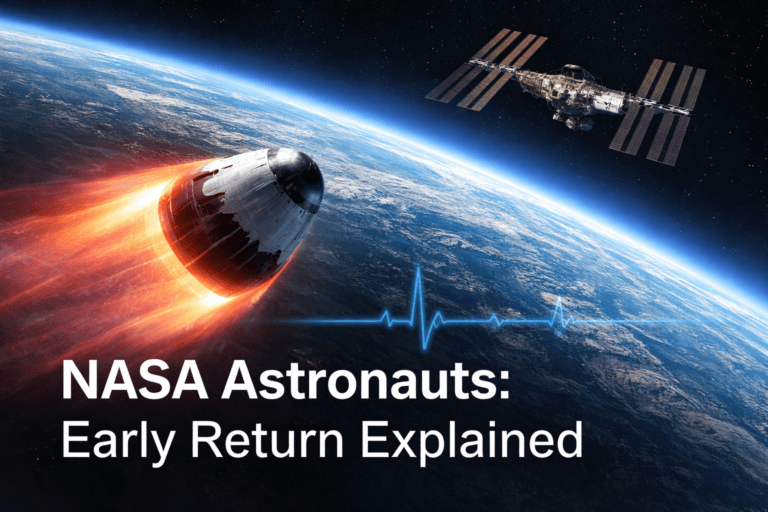
Searches for “NASA astronauts”, “Crew-11 return to Earth”, and “ISS medical issue” have surged in recent days after NASA confirmed an earlier-than-planned Crew-11 departure window tied to a medical concern. Here’s what’s actually confirmed, what’s still unknown, and why this is trending right now.
Part of the Insight Trends Explained series.
→ View the full index of insight-related search spikes.
✅ Here’s what’s confirmed — and what isn’t (Reality Check)
- NASA and SpaceX set a target undocking time for Crew-11: NASA said Crew-11 is targeting no earlier than 5 p.m. ET on Wednesday, Jan. 14, 2026, pending conditions like weather.
- The return timing is connected to a medical concern: Reuters reported NASA is bringing the crew back early due to a medical issue affecting one crewmember, because it can’t be treated fully on station.
- NASA has not disclosed the astronaut’s identity or medical details: Reporting notes the condition is described as stable/non-urgent in coverage, but specifics are withheld for privacy.
If you’re seeing posts claiming “ISS emergency confirmed” or “astronaut evacuated in a crisis,” those claims are still speculative at this stage.
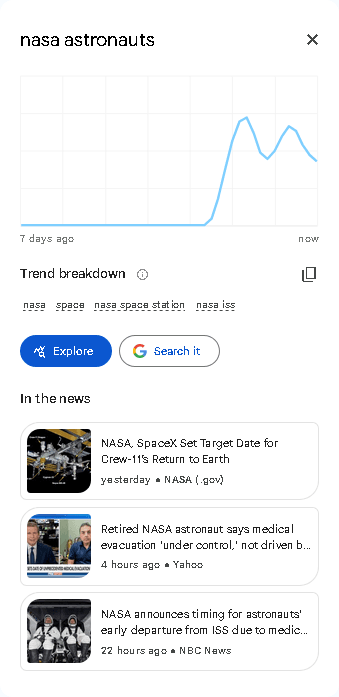
Google Trends Data
⚠️ What’s Still Unknown
- What the medical issue actually is (diagnosis and severity aren’t public).
- Which crew member is affected, and what follow-up care will look like after splashdown.
- Whether additional schedule changes happen (NASA schedules can shift based on weather, spacecraft readiness, and station operations).
🔥 Why This Is Trending Right Now
Several forces are driving the sudden spike in interest:
- Primary Trigger
NASA publicly set a specific return target for Crew-11 after acknowledging a medical concern—anything involving astronaut health reliably drives searches. - Market or Cultural Pressure
Spaceflight audiences are already primed for “crew safety” headlines; even routine operational changes can read as alarming when framed around medical risk. - Algorithmic Amplification
Short, high-emotion keywords (“medical evacuation,” “ISS,” “astronaut”) spread fast across news feeds and social platforms, turning a narrow operational update into broad public curiosity.
This follows a familiar pattern:
Announcement → Curiosity → Anxiety → Search spike
🧭 What This Means If You’re Affected
The Upside
- The crew member gets definitive diagnosis and care sooner (ground-based medicine is far more capable than in-orbit capability).
- NASA shows conservative risk management (prioritizing health even when it disrupts schedules).
- Public visibility increases (more transparent timelines and updates as key events approach).
In short: health-first decisions reduce downside risk.
The Tradeoffs
- Reduced crew time on station can shift research priorities and tasking.
- Operational reshuffles (who remains onboard, what gets delayed) can create short-term uncertainty.
- Speculation risk rises when medical details are rightly withheld.
⏳ Should You Act Now — Or Wait?
You might want to wait if:
- You’re seeing viral claims without NASA confirmation.
- You only have headlines, not primary-source timelines.
- You’re trying to draw conclusions from privacy-limited medical info.
You may not want to wait if:
- You’re following the mission and want official timing for undocking/landing windows.
- You need reliable summaries for classrooms, content, or reporting.
- You’re monitoring whether NASA announces additional operational changes.
Right now, this is best described as: confirmed (schedule + medical concern), with unknown details (diagnosis).
👀 What to Watch Next
If this trend continues, the next key signals will likely be:
- NASA coverage of undocking + splashdown updates (timing can move with weather).
- Operational updates about station staffing and command transitions.
- Post-landing statements (often the first time you’ll hear anything more concrete, even if limited).
Once those land, searches will likely shift from:
“What is it?” → “Is it serious?” → “What happens next?”
❓ FAQ — NASA Astronauts / Crew-11 Early Return
Is Crew-11’s early return officially confirmed?
Yes. NASA and SpaceX announced a target undocking date/time and tied the earlier return to a medical concern.
When is Crew-11 expected to depart the ISS?
NASA is targeting no earlier than 5 p.m. ET on Wednesday, Jan. 14, 2026 (conditions permitting).
Is this an emergency evacuation?
NASA has described it as a medical concern requiring an earlier return; reporting indicates the situation is stable/non-urgent, but details are private.
Why won’t NASA share the medical details?
Astronaut medical specifics are typically not released publicly for privacy and operational reasons; coverage notes NASA hasn’t identified the crew member or diagnosis.