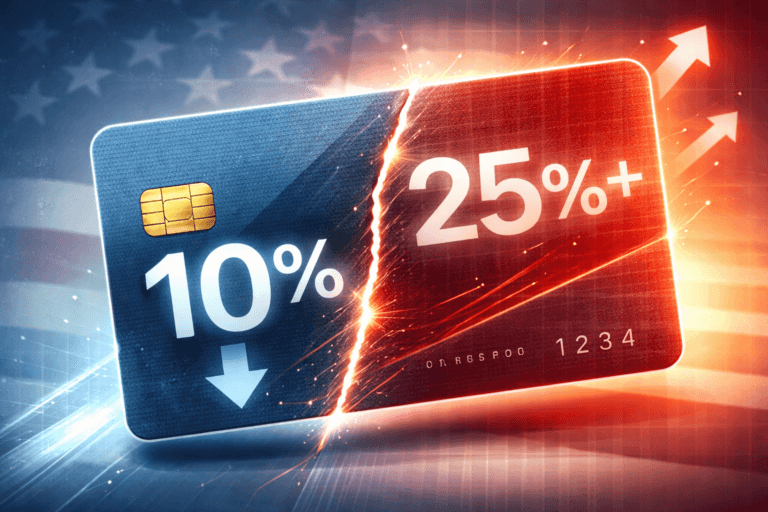
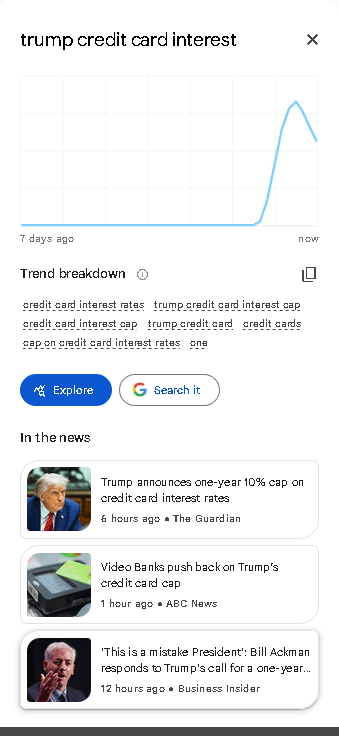
Searches for “trump credit card interest”, “credit card interest cap”, and “10% credit card interest rate cap” have surged in recent hours after President Donald Trump said he’s calling for a one-year 10% cap starting Jan. 20, 2026.
Part of the Market Trends Explained series.
→ View the full index of Markets-related search spikes.
✅ Here’s what’s confirmed — and what isn’t (Reality Check):
- Confirmed: Trump publicly called for a one-year cap of 10% on credit card interest rates starting Jan. 20, 2026.
- Confirmed: He did not explain the legal mechanism or how companies would be made to comply.
- Confirmed: Major banking trade groups immediately warned a 10% cap could reduce credit availability and push borrowers toward costlier alternatives.
Google Trends Data
⚠️ What’s Still Unknown
- Whether this becomes law, stays a political call, or turns into a specific bill with enforceable rules.
- What exactly would be covered: existing balances vs new charges, all cards vs certain products, and whether issuers would shift costs into fees/rewards cuts.
- Enforcement details: which regulator, what penalties, and how it interacts with longstanding bank card pricing/legal structure.
If you’re seeing posts claiming “10% APR cap is officially happening Jan 20”—that’s still speculative until there’s an enforceable policy (typically legislation and implementation details).
🔥 Why This Is Trending Right Now
Several forces are driving the spike:
- Primary Trigger
Trump’s social post explicitly called for a 10% cap starting Jan. 20, 2026. - Market or Cultural Pressure
Credit card APRs remain historically high (often cited around ~20% on average), and credit card balances/debt levels have been a major affordability issue. - Algorithmic Amplification
The announcement hit major outlets quickly and sparked loud pushback/support from prominent figures (including Bill Ackman’s criticism), accelerating search behavior.
Pattern: Announcement → Curiosity → Anxiety → Search spike
🧭 What This Means If You’re Affected
The Upside
- If it became enforceable and applied broadly, interest costs could drop sharply for people carrying revolving balances.
- Could create real short-term relief in a high-APR environment.
- Adds pressure for Congress to revisit rate-cap legislation already introduced.
In short: If it becomes real policy, it could be meaningful relief—especially for people paying 20%+ APR.
The Tradeoffs
- Issuers may respond by cutting credit lines, tightening approvals, reducing rewards, or shifting revenue into fees.
- Higher-risk borrowers could be pushed toward BNPL, payday, pawn, or other costlier credit.
- The plan may never become enforceable without Congress, making it noise until details emerge.
You might want to wait if:
- You’re hoping the cap will automatically lower your APR soon (that’s not confirmed).
- You’d need details on whether it applies to existing balances (unknown).
- You’re deciding on a major move (refi, big purchases) based on headlines alone.
You may not want to wait if:
- You’re carrying a high balance at 20%+ APR—interest is compounding right now, regardless of politics.
- You can qualify for 0% balance transfer or a lower-rate consolidation loan (even temporary relief can help).
- You’re at risk of missed payments—fees and penalty APR dynamics can hurt fast (and recent regulatory fights show rules can change).
Right now, this is best described as: speculative (policy intent announced, enforcement unclear).
👀 What to Watch Next
If this trend continues, the next key signals will likely be:
- A specific bill getting White House backing, committee action, or votes (watch Congress).
- Statements from regulators/administration on implementation and compliance.
- Bank/issuer moves: tightened underwriting, rewards changes, fee restructuring.
Then searches usually shift:
“What is it?” → “Will it pass?” → “How do I take advantage?”
❓ FAQ — Trump 10% Credit Card Interest Cap
Is the 10% cap officially confirmed?
Trump publicly called for it, but enforceable implementation details are not provided yet.
When would it start?
Trump said Jan. 20, 2026, for one year—but that timing depends on whether it becomes enforceable policy.
Would this lower my current APR automatically?
Unknown. Whether it applies to existing balances vs new charges hasn’t been specified.
Could banks cancel cards or cut credit lines?
Possibly. Industry groups and some critics argue issuers could reduce credit availability if they can’t price risk.