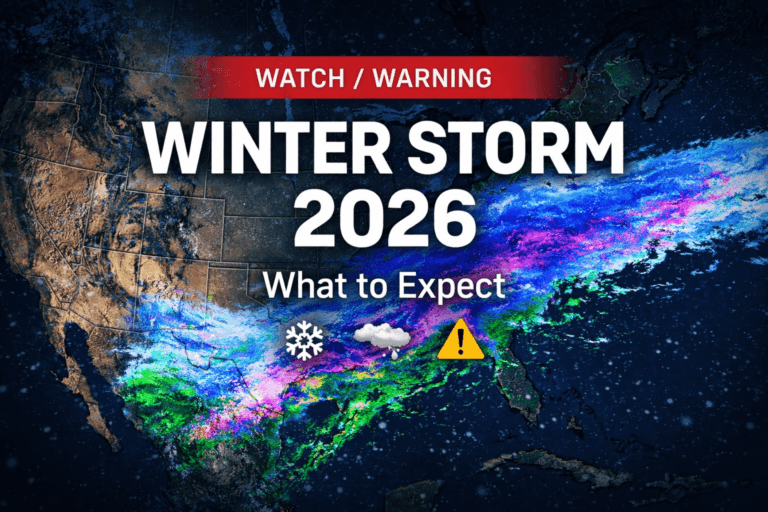
Searches for “winter storm watch,” “how much snow are we getting,” and “winter storm warning” have surged in recent days after a massive U.S. system—often branded “Winter Storm Fern” by The Weather Channel—triggered widespread warnings, flight cancellations, and power outages. Here’s what’s actually confirmed, what’s still unknown, and why this is trending right now.
✅ Here’s what’s confirmed — and what isn’t (Reality Check)
- “Winter Storm Fern” is a media name, not an official NOAA/NWS storm name. The Weather Channel commonly names winter storms for coverage and tracking.
- The storm’s impact is real and widespread: Reuters reports thousands of flight cancellations and 100,000+ power outages, with multiple states declaring emergencies as the system spreads across much of the U.S.
- Official winter products are active (Watch/Warning): NWS defines a Winter Storm Watch as “potential for significant/hazardous winter weather within ~48 hours,” while Warnings indicate hazardous winter weather is expected or occurring.
- Radar + alerts are centralized on NWS tools: The NWS radar mosaic and alert overlays are available on NOAA/NWS radar products.
- Airlines are actively adjusting schedules and issuing waivers: Delta published a Winter Storm Fern update and posted travel waiver guidance for rebooking.
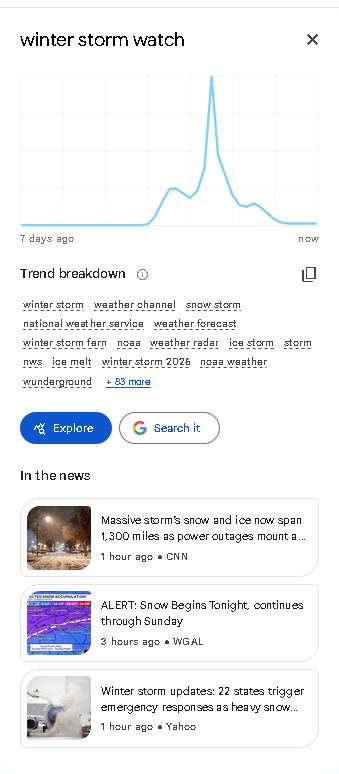
Google Trends Data
⚠️ What’s Still Unknown
- Exact snowfall totals “at your address” (snow banding can shift totals dramatically over short distances). National coverage can’t guarantee local inches.
- Where the worst ice ends up (ice placement is a major driver of outages and tree damage). Reuters specifically highlights ice impacts around Atlanta and broader East Coast operations.
- How long disruption lingers (even after precipitation ends, extreme cold can slow recovery, re-freeze roads, and extend travel issues).
If you’re seeing posts claiming “X inches confirmed for everyone”, treat those as too confident until your local NWS office updates the warning details.
🔥 Why This Is Trending Right Now
Several forces are driving the sudden spike in interest:
- Primary Trigger
A large storm is actively producing measurable disruption: flight cancellations, outages, and emergency declarations—which instantly drives “watch/warning/radar” searches.. - Market or Cultural Pressure
People are highly primed to search because winter storms affect work, travel, school closures, and safety planning—and this one is being described by official and major outlets as unusually broad/serious. - Algorithmic Amplification
Big storms create high click-through content (maps, “live updates,” travel alerts), which accelerates visibility across news + social platforms—driving more searches.
This follows a familiar pattern:
Announcement → Curiosity → Anxiety → Search spike
🧭 What This Means If You’re Affected
The Upside
- You have time to plan because warnings include clear windows (e.g., Sat night → Sun → Mon).
- If you prepare early, you can reduce risk: avoid peak travel, stock essentials, and protect vehicles/property.
- Better decision-making: knowing the difference between Watch vs Warning helps cut through panic posts.
In short: the sooner you align plans to the warning window, the less this storm controls your schedule.
The Tradeoffs
- Travel disruption is likely, including potential road hazards and cancellations/delays.
- Power outage risk increases where ice/wind plays a role; outages are already reported in parts of the storm footprint.
- Cold and recovery lag: extreme cold can make road clearing and restoration slower.
⏳ Should You Act Now — Or Wait?
You might want to wait if:
- You’re not traveling and you already have essentials, and your area is likely to see lighter totals than the warning’s upper range.
- You can work from home and don’t need to be on roads Sunday.
- Your local alert is still a Watch (possible) and hasn’t upgraded to a Warning yet.
You may not want to wait if:
- You must drive during the core window (late Sat night → Sun).
- You rely on electrically powered medical equipment or have low tolerance for outages.
- You have a flight scheduled (nationally, cancellations are significant).
Right now, this is best described as: confirmed (for warning areas) and high-impact (nationally)—with local severity determined by your local NWS products..
👀 What to Watch Next
If this trend continues, the next key signals will likely be:
- Local NWS updates (warning expansions/reductions; updated timing/amounts).
- Ice-line adjustments (big swing factor for outages and tree damage).
- Flight/airport operations (waivers + cancellation volumes).
Once those land, searches will likely shift from:
“What is it?” → “Is it worth it?” → “Should I buy?”
(For storms: “What is it?” → “Will it hit me?” → “Should I travel?”)
❓ FAQ — Winter Storm Watch
Is “Winter Storm Fern” an official NOAA/NWS designation?
No. “Fern” is used in media coverage (notably The Weather Channel). Your official local status comes from NWS watches/warnings.
What does a Winter Storm Watch mean?
It means significant, hazardous winter weather is possible, generally within about 48 hours (not guaranteed).
What does a Winter Storm Warning mean?
A warning indicates hazardous winter weather is expected or occurring. NWS guidance also shows common warning thresholds (example office guidance: heavy snow amounts, sleet criteria).
How can I track this fast without doomscrolling?
Use NWS Radar for live precipitation and the NWS site for active alerts + official forecast products.
Are flight cancellations tied to this storm?
Yes—Reuters reports widespread cancellations, and Delta has published updates and travel waivers for impacted regions.
📚 Sources & Technical Background
- Reuters — outages + flight cancellations + emergency actions (2026)
- Reuters — Delta cancellations + ice risk + hub impacts (2026)
- The Weather Channel (weather.com) — “Winter Storm Fern” naming + broad footprint (2026)
- National Weather Service — Watch definition (evergreen)
- National Weather Service — Radar (official tool)
- Delta — travel waiver / storm updates (2026)
- NWS Winter Safety / preparation guidance (evergreen)